 https://doi.org/10.63923/smhs.2026.141
Abstract
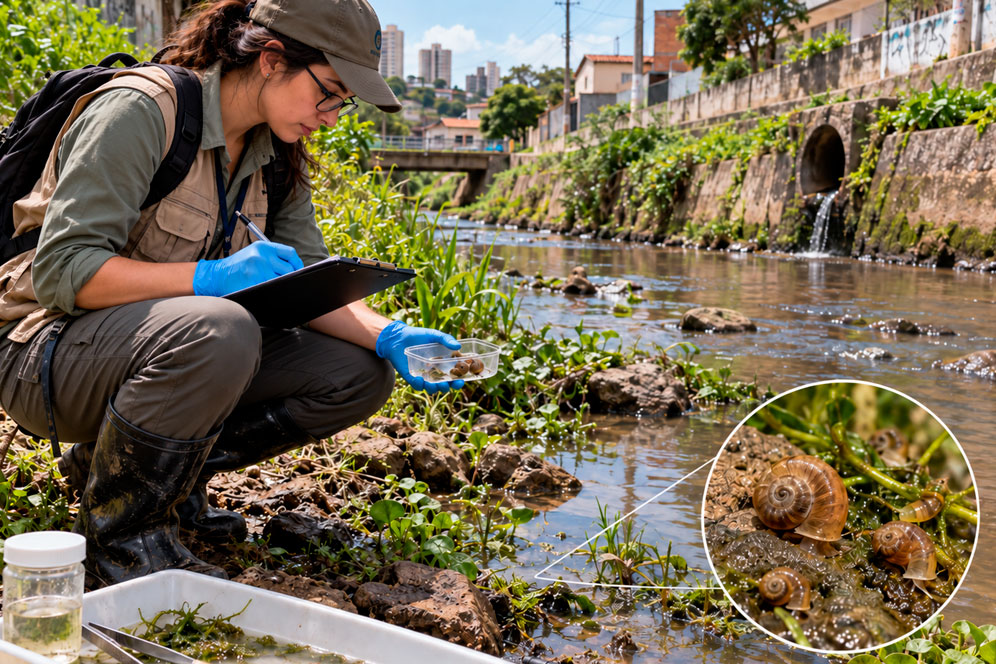
Schistosomiasis remains an important public health problem in Espírito Santo, Brazil, particularly in municipalities characterized by greater socioeconomic vulnerability, frequent contact with freshwater bodies, and inadequate sanitation coverage. This study aimed to investigate the associations between the occurrence of snails of the genus Biomphalaria, the historical occurrence of Schistosoma mansoni at the municipal level, sanitation indicators, and schistosomiasis positivity across municipalities in the state of Espírito Santo (ES). This longitudinal ecological study used secondary data from 2011 to 2019 and included 2,766 investigated cases in ES. Descriptive analyses, analysis of variance, Pearson’s chi-square test, and multiple linear regression were performed. An overall decreasing trend in the number of cases was observed throughout the study period. Biomphalaria species richness was not significantly associated with the schistosomiasis test positivity rate. In contrast, the presence of B. glabrata and a history of S. mansoni occurrence in the municipality were significantly associated with higher schistosomiasis positivity rates. Conversely, the occurrence of B. straminea and B. tenagophila was negatively associated with schistosomiasis positivity, whereas sewage treatment coverage, total population size, and the proportion of the population living in urban areas were not associated with the positivity rate after adjustment for the effects of the other variables. These findings indicate that the presence of Biomphalaria alone does not explain the municipal distribution of schistosomiasis, while highlighting the epidemiological relevance of B. glabrata compared with other congeneric species recorded in Espírito Santo, as well as the importance of previous S. mansoni occurrence. These results reinforce the need to integrate epidemiological surveillance, malacological surveillance, expansion of sanitation services, and molecular methods for Biomphalaria species identification to improve the identification of areas at risk and strengthen schistosomiasis control strategies in Espírito Santo.
References
- CALDEIRA, R. L.; VIDIGAL, T. H. D. A.; MATINELLA, L.; SIMPSON, A. J. G.; CARVALHO, O. S. Identification of planorbids from Venezuela by polymerase chain reaction amplification and restriction fragment length polymorphism of the ITS of the RNA ribosomal gene. Memórias do Instituto Oswaldo Cruz, Rio de Janeiro, v. 95, n. 2, p. 171-177, 2000. DOI: 10.1590/S0074-02762000000200006.
- CARNEIRO, A. T. M. et al. Estudo Epidemiológico da Esquistossomose no Brasil. Brazilian Journal of Implantology and Health Sciences, Macapá, v. 7, n. 8, p. 1333–1347, 2025. Disponível em: doi.org.
- CARVALHO, O. D. S., Mendonça, C. L. F., Teles, H. M. S., Finau, J., Caldeira, R. L., Scholte, R. G. C., & Mesquita, S. G. (2020). Moluscos hospedeiros intermediários de Schistosoma mansoni do Brasil. Belo Horizonte/Instituto René Rachou/Fiocruz.
- CARVALHO, O. S.; AMARAL, R. S. Biomphalaria glabrata, principal hospedeiro intermediário de Schistosoma mansoni no Brasil. In: CARVALHO, O. S.; COELHO, P. M. Z.; LENZI, H. L. (Org.). Schistosoma mansoni e Esquistossomose: uma visão multidisciplinar. Rio de Janeiro: Editora FIOCRUZ, 2008. p. 393-418.
- CARVALHO, O. S.; COELHO, P. M. Z.; LENZI, H. L. (Org.). Schistosoma mansoni e esquistossomose: uma visão multidisciplinar. Rio de Janeiro: Editora FIOCRUZ, 2008. 1124 p.
- COIMBRA JÚNIOR, C. E. A.; ENGEL, L. A. Suscetibilidade de Biomphalaria occidentalis do Acre e do Mato Grosso à infecção pelo Schistosoma mansoni e sua implicação na epidemiologia da esquistossomose na Amazônia Ocidental, Brasil. Acta Amazonica, Manaus, v. 12, n. 4, p. 795-799, 1982. DOI: 10.1590/1809-43921982124795.
- CONCEIÇÃO, M. M. et al. Aspectos hídricos e epidemiológicos da transmissão da esquistossomose mansônica. Revista Saúde e Biologia, v. 11, n. 2, p. 55-64, 2016.
- CRUZ, W. M. et al. Saneamento básico inadequado e condições de saúde relacionadas: uma revisão integrativa. Physis: Revista de Saúde Coletiva, Rio de Janeiro, v. 35, n. 2, e350236pt, 2025. Disponível em: doi.org.
- ESPÍRITO SANTO (Estado). Secretaria de Estado da Saúde. Boletim Epidemiológico da Esquistossomose 2023: Superintendência Regional de Saúde de Vitória. Vitória: SESA, 2023. Disponível em: saude.es.gov.br.
- ESPÍRITO SANTO (Estado). Secretaria de Estado da Saúde. Vigilância da Esquistossomose Mansoni: diretrizes técnicas. Vitória: SESA, 2010.
- FREITAS, B. S.; BERGER, M. S.; VOLPI, S. J. Esquistossomose: compreendendo os fatores para alta prevalência da doença em um município endêmico no Estado do Espírito Santo. Natureza Online, [s. l.], v. 20, n. 1, p. 1-13, jan./abr. 2022. Disponível em: naturezaonline.com.br.
- GAZZINELLI, A. et al. Socioeconomic determinants of schistosomiasis in a poor rural area in Brazil. Acta Tropica, v. 99, n. 2-3, p. 260-271, 2006. DOI: 10.1016/j.actatropica.2006.09.001.
- GRIMES, J. E. T. et al. The relationship between water, sanitation and schistosomiasis: a systematic review and meta-analysis. PLoS Neglected Tropical Diseases, v. 8, n. 12, p. e3296, 2014. DOI: 10.1371/journal.pntd.0003296.
- GRIMES, J. E. T. et al. The roles of water, sanitation and hygiene in reducing schistosomiasis: a review. Parasites & Vectors, v. 8, p. 156, 2015. DOI: 10.1186/s13071-015-0766-9.
- NAHAS, Maria Inês Pedrosa; MOURA, Arlete Soares Alves de; CARVALHO, Rodrigo Coelho de; HELLER, Léo. Desigualdade e discriminação no acesso à água e ao esgotamento sanitário na Região Metropolitana de Belo Horizonte, Minas Gerais, Brasil. Cadernos de Saúde Pública, v. 35, n. 4, e00100818, 2019. Disponível em: doi.org.
- OLIVEIRA, D. S. et al. Schistosomiasis mansoni in urban Northeast Brazil: influence of rainfall regime on the population dynamics of Biomphalaria sp. Revista da Sociedade Brasileira de Medicina Tropical, v. 46, n. 5, p. 654-657, 2013. DOI: 10.1590/0037-8682-1671-2013.
- OLIVEIRA, M. A. M.; LINS, C. M. L.; COSTA, L. B. B. Análise da esquistossomose no Sudeste (2013-2023). Revista Ibero-Americana de Humanidades, Ciências e Educação, São Paulo, v. 11, n. 3, p. 1173–1187, mar. 2025. DOI: doi.org.
- PARAENSE, W. L. Biomphalaria occidentalis sp. n. from South America (Mollusca Basommatophora Pulmonata). Memórias do Instituto Oswaldo Cruz, Rio de Janeiro, v. 76, n. 2, p. 199-211, 1981. DOI: 10.1590/S0074-02761981000200010.
- PARAENSE, W. L. Distribuição dos caramujos no Brasil. In: REIS, F. A.; FARIA, I.; KATZ, N. (Ed.). Modernos conhecimentos sobre esquistossomose mansônica. Belo Horizonte: Academia Mineira de Medicina, 1986. p. 117-128.
- PARAENSE, W. L.; CORRÊA, L. R. Unsusceptibility of Biomphalaria occidentalis to infection with a strain of Schistosoma mansoni. Memórias do Instituto Oswaldo Cruz, Rio de Janeiro, v. 77, n. 1, p. 55-58, 1982. DOI: 10.1590/S0074-02761982000100006.
- PIZA, J. T.; RAMOS, A. S.; BRANDÃO, C. S. H.; CAMARGO, L. S.; CASTRO, N. F. A carta planorbídica do Estado de São Paulo. São Paulo: Secretaria de Estado da Saúde (Campanha de Combate à Esquistossomose), 1972.
- RAMOS, R. F. (2018). Modelagem de nicho ecológico de Biomphalaria spp (Preston, 1910) no Estado do Espírito Santo-Brasil.
- SANTOS, M. C. S. et al. Schistosomiasis, soil-transmitted helminthiases and sanitation: a cross-sectional study in a low-endemic area in Brazil. Revista do Instituto de Medicina Tropical de São Paulo, v. 65, e41, 2023.
- SANTOS, M. C. S.; OLIVEIRA, G. L.; MINGOTI, S. A.; HELLER, L. Effect of environmental factors in reducing the prevalence of schistosomiasis in schoolchildren: an analysis of three extensive national prevalence surveys in Brazil (1950-2018). PLoS Neglected Tropical Diseases, v. 17, n. 7, e0011480, 2023.
- SOUZA, H. P. de et al. Doenças infecciosas e parasitárias no Brasil de 2010 a 2017: aspectos para vigilância em saúde. Revista Panamericana de Salud Pública, v. 44, e10, p. 1-11, 2020. Disponível em: doi.org.
- SOUZA, M. D. R.; DE JESUS, D. M. S.; SANTOS, A. H. C.; et al. Risk clusters of Schistosoma mansoni infection in an endemic state of Brazil: space-time modelling and association with socio-economic and environmental factors. Transactions of the Royal Society of Tropical Medicine and Hygiene, v. 116, n. 2, p. 135-145, 2022.
- SOUZA, R. Z. R. Ecoepidemiologia da esquistossomose mansoni em áreas de baixa endemicidade no estado do Espírito Santo, Brasil. 2018. Dissertação (Mestrado em Doenças Infecciosas) - Universidade Federal do Espírito Santo, Vitória, 2018.
- SPAMER, H. (2016). Migração e identidade étnica pomerana no Espírito Santo. I Colóquio Internacional de Mobilidade Humana e Circularidade de Ideias.
- TELES, H. M. S. Distribuição de Biomphalaria tenagophila e B. occidentalis no Estado de São Paulo (Brasil). Revista de Saúde Pública, São Paulo, v. 23, n. 3, p. 244-253, 1989. DOI: 10.1590/S0034-89101989000300009.
- TEODORO, T. M.; JANOTTI-PASSOS, L. K.; CARVALHO, O. S.; CALDEIRA, R. L. Occurrence of Biomphalaria cousini (Mollusca: Gastropoda) in Brazil and its susceptibility to Schistosoma mansoni (Platyhelminths: Trematoda). Molecular Phylogenetics and Evolution, v. 57, n. 1, p. 144-151, 2010. DOI: 10.1016/j.ympev.2010.05.019.
- VAZ, J. F.; TELES, H. M. S.; CORRÊA, M. A.; LEITE, S. P. S. Ocorrência no Brasil de Biomphalaria occidentalis Paraense, 1981, em um foco de esquistossomose mansônica. Revista de Saúde Pública, São Paulo, v. 17, n. 5, p. 343-361, 1983. DOI: 10.1590/S0034-89101983000500001.